My Account

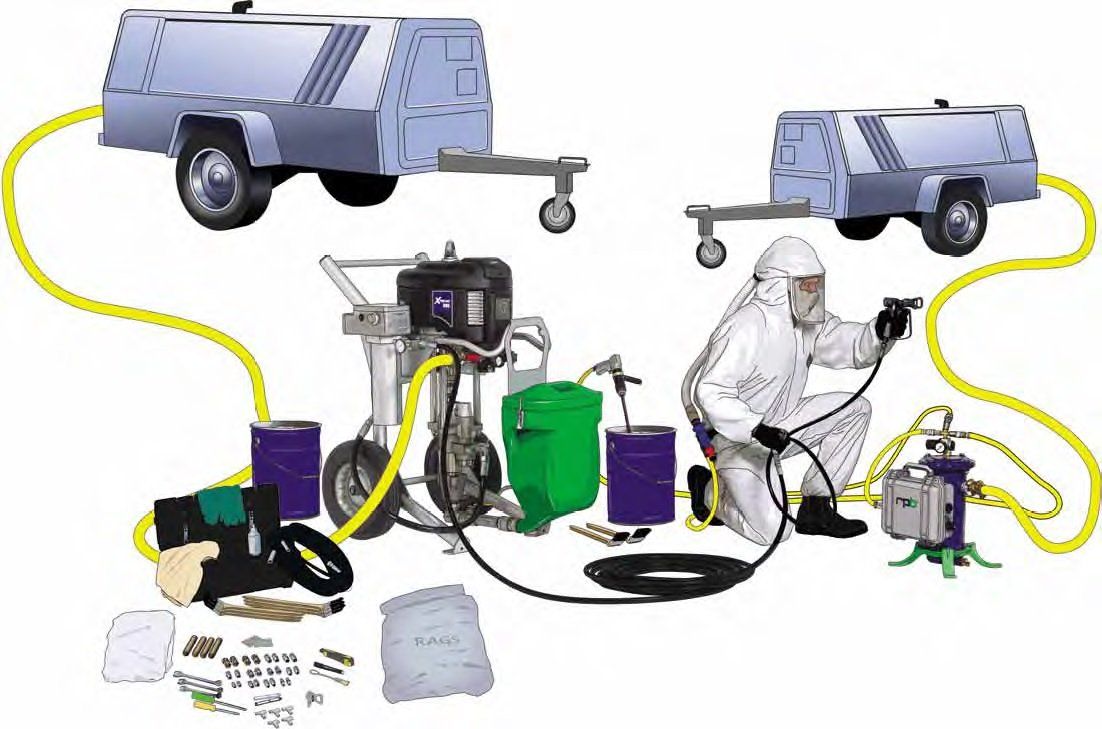
| PAINT COMPONENTS |
DAILY CHECKLIST
|
||
|
PRE-REQUIREMENTS
|
|||
| P1 Air Compressor | |||
| • Fully maintained and serviced | |||
| • Capable of 125psi discharge pressure | |||
| • Positioned upwind and away from working area | |||
| • High volume of breathing air quality if separate dedicated compressor not used | |||
| • High temperature safety cut out | |||
| • Oil and particulate filter separator | |||
| P2 Paint Air Supply Hose | |||
| • Large bore hose | |||
| • Large connector fittings with whipchecks and/ or safety chains installed |
|||
| P3 Paint Pump | |||
| • Fully maintained and serviced on a regular basis | |||
| • Check and top up throat seal liquid daily | |||
| • Completely cleaned immediately after each operation |
|||
| • Keep pump ‘wet’ at all times – leave solvent in pump after use, for long storage periods, use Diesel, Kerosine or Pump Armor |
|||
| P4 Paint Line | |||
| • Rated pressure must be greater than maximum rated pressure of pump and undamaged | |||
| P5 Paint Line Whip Hose | |||
| • Rated pressure must be greater than maximum rated pressure of pump and undamaged | |||
| P6 Spray Gun | |||
| • Check Spray Gun is clean and fully operational (clean with thinners, etc.) |
|||
| • Ensure Tip Guard is in place | |||
| • Ensure correct tip size is used for product being applied | |||
| • Ensure gun rated pressure is above pump rated pressure | |||
| P7 Reversible Air Drill and Mixer/Stirrer | |||
| • Ensure Air Drill is in good working order | |||
| • Mixer/Stirrer is clean and free from contaminants | |||
| • For 2 component coatings – 2 Air Drills and Mixer/Stirrers required |
|||
| P8 Drum(s) for Mixing Paint | |||
| • Clean straight sided tin(s) for mixing paint | |||
| P9 Painter’s Tool Box | |||
| • Contains spares, tools, gloves for mixing, brushes, fittings, etc | |||
| P10 Extra Drum | |||
| • Disposal drum for waste paint and used Thinner residue | |||
| P11 Bag of Rags | |||
| • These are a must for general use and any spills or leaks | |||
Spray Painting System: Daily Component Checklist
| OPERATOR SAFETY COMPONENTS |
DAILY CHECKLIST
|
||
|
PRE-REQUIREMENTS
|
|||
| S1 Breathing Air Source | |||
| • Checked and maintained on a regular basis | |||
| • Located in a clean air atmosphere, upwind and away from the blast area and engine exhaust fumes | |||
| • Approved air compressor or dedicated breathing air compressor or air pump or bottled breathing air or other approved supply | |||
| S2 Breathing Air Filter | |||
| • Cartridges require regular programmed replacement | |||
| • Cartridges require regular programmed replacement | |||
| S3 Carbon Monoxide Monitor or Converter Monitor | |||
| • Checked, tested and calibrated on a routine basis | |||
| • Samples air and safeguards against toxic, carbon monoxide gas | |||
| • Ensures carbon monoxide level is below 10ppm (11 milligram/m³) as per AS1715 | |||
| S4 Breathing Air Line | |||
| • Fitted with threaded screw-type connector or AS 1715 approved ‘Safety Type’ coupling with two distinct actions required for disconnection | |||
| • AS Standard approved and marked | |||
| S5 Climate Control Tube | |||
| • Air temperature control within 15°C – 25°C range for operator comfort | |||
| • Complies with requirements of AS 1715 | |||
| S6 Blast Helmet (Respirator) | |||
| • Inspected and maintained for wear and tear to the cape, collar, head gear and visor as per AS 1715 requirements | |||
| • Inner lens in place for impact protection | |||
| • Supplied with minimum 170 liters/minute breathing quality air as per AS 1715 | |||
| • Air quality regularly tested and test records maintained as per AS 1715 requirements to check the following levels of contaminants: Oil below 1 milligram/m³, Carbon Monoxide below 10 ppm (11 milligrams/m³), Carbon Dioxide below 800 ppm (1400 milligrams/m³), Oxygen between 19.5 and 22.0% |
|||
| • Issued on an exclusive use basis (or shared use only with an AS 1715 approved programme for extensive and stringent cleaning, disinfecting, and recording) | |||
| • Earplugs and/or earmuffs essential for hearing protection | |||
| • Optional communication equipment | |||
| • Optional blast light illumination kit | |||
| S7 Other Protective Clothing | |||
| • Leather gloves/gauntlets | |||
| • Blast suit/protective overalls | |||
| • Safety footwear | |||
| S8 Work Hazards | |||
| Check, control and eliminate wherever possible: | |||
| • Physical dangers – tripping, falling, crushing | |||
| • Toxic substances e.g. lead, arsenic, cyanide, heavy metals, chromates, free silica, etc. present either in the abrasive, the coating, the substrate or the environment | |||
DISCLAIMER: The above information is only a guide and does not represent nor claim to be either a full or complete or accurate nor an approved or standard method of checking blast cleaning equipment or components. It is the responsibility of the reader and/or users of this information to separately determine and verify each and/or any guideline, regulations, tests, checks, etc. for equipment and/or setup as directed or indicated or required in or by any work specifications and/or standards. Blast-One™ expressly disclaims any liability for the use or misuse of the above information.
Read More Posts
Blast Hose Safety Checklist
BLASTHOSE SAFETY CHECKLIST Quick daily inspection steps for blast hose, couplings, and nozzle holders. Daily Use Checklist ✅ Daily Inspection Perform a visual check of the entire hose before blasting. Look for cracks, splits, bubbles, or holes in the outer casing. Inspect hose couplings for tight fit, damage, or excessive wear. ✅ Squeeze Test Squeeze […]